

The digital advertising landscape of 2026 has fragmented into two distinct philosophies: the interruptive social commerce of Meta and the embedded ecosystem of TikTok Shop. For sellers, the choice is no longer about which platform has more users, but which one converts those users into buyers at a lower Customer Acquisition Cost (CAC).
The Core Difference: Native Checkout vs. External Traffic
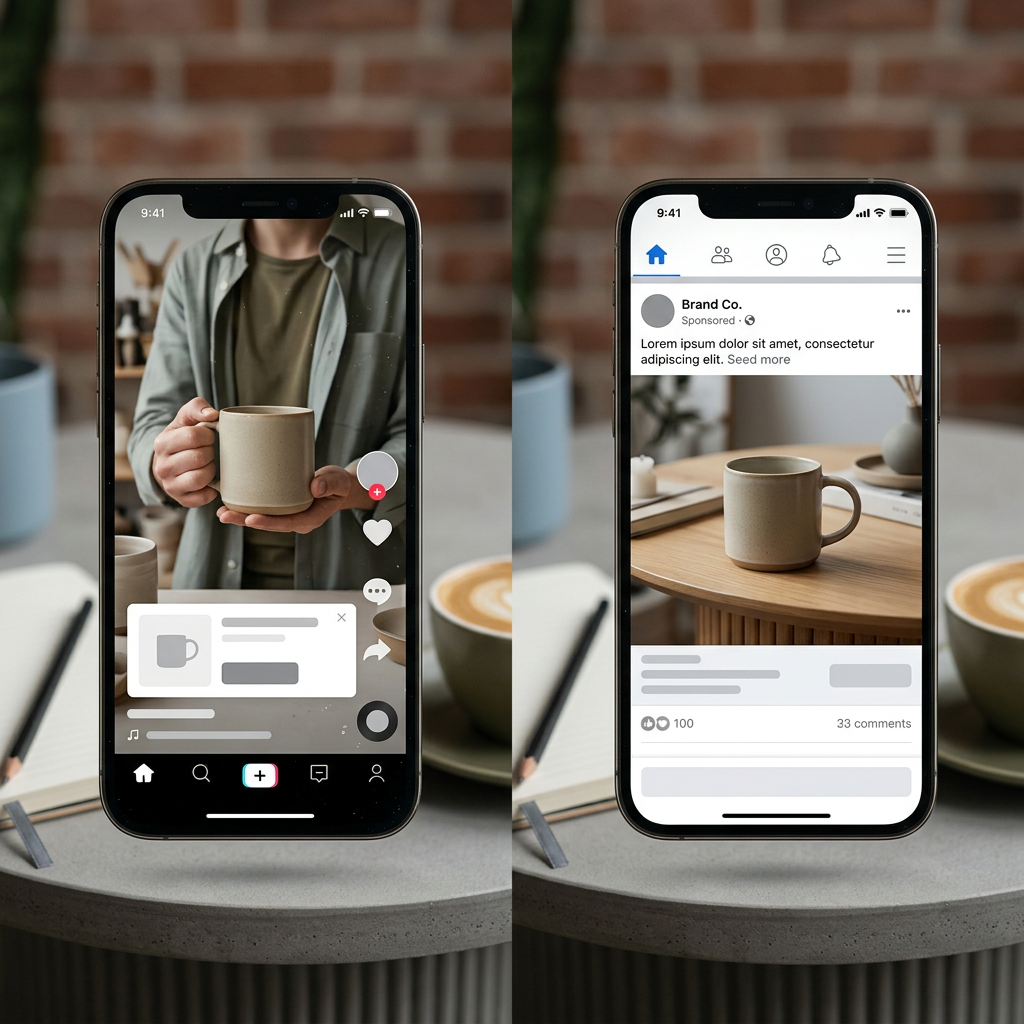
In 2026, the primary differentiator between TikTok Shop ads and Facebook ads is the proximity to the 'Buy' button. Facebook ads (Meta Ads) primarily function as a traffic driver, sending users to an external Shopify or BigCommerce site. While Meta has refined its 'Shops' feature, the vast majority of high-volume sellers still push traffic away from the app.
Conversely, TikTok Shop ads represent a closed-loop system. When a user clicks a TikTok Shop ad, the transaction happens entirely within the TikTok interface using pre-saved shipping and payment data. This removes the friction of page load times and mobile-unfriendly checkouts. Sellers moving from traditional models often weigh TikTok Shop vs Shopify dropshipping to determine if this platform-native checkout outperforms the control of an independent site.
Conversion Rate Benchmarks
- TikTok Shop Ads: 4.5% – 8% (Native checkout advantage)
- Facebook Ads (to External Site): 2.0% – 4% (Friction during redirect)
Ad Formats and Creative Strategy
Facebook ads in 2026 rely heavily on the 'Advantage+' AI suite. Success on Meta often comes from high-production static images, carousels, and polished video ads that can withstand long-term frequency. Meta’s algorithm is exceptional at finding 'buyers' even with mediocre creative, provided the pixel data is mature.
TikTok Shop ads, specifically Video Shopping Ads (VSA) and Spark Ads, demand a User-Generated Content (UGC) approach. If your ad looks like an ad, users swipe away. To lower your production costs, using a free TikTok Shop video script generator can help structure hooks that stop the scroll in under two seconds.
Leveraging Spark Ads for Scale
Spark Ads allow sellers to boost organic videos from their own account or from a creator's account. This is the gold standard for 2026 because it retains all social proof—likes, comments, and shares. For a detailed breakdown of this specific mechanic, see our TikTok Shop Spark Ads scaling guide.
Cost Analysis: CPMs and ROAS
Advertising costs have stabilized in mid-2026, but the 'Value per Impression' varies wildly between the two platforms.
| Metric | TikTok Shop Ads (2026) | Facebook Ads (2026) |
|---|---|---|
| Average CPM | $9.00 - $14.00 | $16.00 - $22.00 |
| Average CPC | $0.45 - $0.85 | $0.90 - $1.60 |
| Primary Goal | Direct In-App Sale | Lead Gen / Web Conversion |
| Tracking | First-Party (100% accurate) | Pixel/CAPI (Estimated) |
Meta remains more expensive on a per-impression basis because its audience browsing intent is often broader. TikTok's lower CPMs allow for more aggressive testing, which is essential to find winning TikTok Shop products before the competition saturates the niche.
Tip: Always use a free TikTok Shop commission calculator before setting your daily ad budget. It is easy to ignore the 8% platform fee and affiliate payouts when calculating your break-even ROAS.
Targeting Capabilities and AI Optimization
Meta’s 'pixel' remains the most sophisticated optimization engine in the world. It tracks behavior across millions of third-party websites, allowing Facebook to target users based on their likelihood to purchase a specific category of goods before they even realize they want it.
 TikTok's targeting has caught up significantly in 2026. By utilizing their 'Shop Purchase Intent' signals, TikTok can identify users who have not just watched videos, but have historically added items to their TikTok Shop cart. This first-party data is immune to the privacy restrictions that hampered Meta in previous years, as the data never leaves TikTok’s servers.
The Role of Affiliates and Creators
A unique component of the TikTok Shop ads vs Facebook ads debate is the 'Force Multiplier' of affiliates. On Facebook, you pay for every click. On TikTok, you can run ads alongside an active affiliate program. If an affiliate’s video goes viral, you can 'Spark' that video with spend, effectively subsidizing the creator's reach to drive sales to your shop.
Sellers who maximize this hybrid approach often follow a TikTok Shop affiliate marketing guide to recruit creators who produce the very assets used for advertising. This creates a self-sustaining loop of content and conversions that is difficult to replicate on Meta’s ecosystem without significantly higher overhead.
Compliance and Risk Management
Platform stability is a major concern for 2026 sellers. Facebook is notorious for automated account bans with little recourse. TikTok Shop is equally strict but focuses heavily on logistics and intellectual property. Before scaling your ad spend, ensure you can handle TikTok Shop IP violations to prevent your entire shop—and your ad account—from being deactivated during a peak sales period.
If you are automating your backend, ensure your fulfillment matches the speed of your ads. Many sellers use an AutoDS TikTok Shop integration to manage the surge in orders that typically follows a successful ad campaign launch.
Final Verdict: Which Wins in 2026?
For 2026, TikTok Shop ads win for impulse-purchase products under $50 and brands that can produce high volumes of vertical video content. The native checkout experience offers a conversion rate floor that Meta cannot match.
Facebook ads remain the winner for high-ticket items ($100+), subscription services, and brands that require long-form education or complex sales funnels. Meta’s ability to retarget across Instagram, Facebook, and the Audience Network provides a multi-touchpoint journey that TikTok's high-velocity feed sometimes lacks.
Most successful marketplace sellers in 2026 do not choose one; they use Meta for brand awareness and retargeting, while leveraging TikTok Shop ads for raw volume and customer acquisition. Check out our TikTok Shop ads tutorial to start your first campaign today.
Optimize your listings and maximize your ad budget using the ListerRank suite of free seller tools.
Frequently Asked Questions
Is it cheaper to run ads on TikTok Shop or Facebook in 2026?
Generally, TikTok Shop ads have a lower CPM (cost per thousand impressions) and CPC. However, Facebook ads often lead to a higher Average Order Value (AOV), which can balance out the higher initial costs.
Do I need a website to run TikTok Shop ads?
No. Unlike Facebook ads which usually require an external landing page, TikTok Shop ads allow users to buy products directly within the app using the native TikTok Shop interface.
Can I use Facebook ad creative on TikTok?
It is not recommended. Facebook ads tend to be more polished and 'corporate,' whereas TikTok ads perform best when they look like organic, user-generated content (UGC).
Which platform has better tracking for 2026?
TikTok Shop offers superior tracking for its internal ads because the entire transaction occurs within the platform, providing 100% attribution without relying on browser cookies or external pixels.