

Relying solely on Amazon’s estimated payout is the fastest way to drain your bank account without realizing where the leaks are coming from. As of June 2026, the marketplace's complexity—ranging from inventory placement surcharges to volatile storage rates—demands a level of tracking that basic calculators cannot provide. To build a sustainable brand, you need a dedicated Amazon FBA overhead cost spreadsheet for beginners that captures operational expenses (OpEx) alongside per-unit fees.
The Difference Between Per-Unit Fees and Overhead
Most new sellers confuse COGS (Cost of Goods Sold) and FBA fees with the total cost of doing business. While a free Amazon FBA calculator is vital for determining the viability of a specific product, it doesn't account for your monthly software subscriptions, office supplies, or professional legal fees.
Overhead is the "quiet" expense that exists regardless of whether you sell one unit or one thousand. If your spreadsheet only tracks the product-level margins, you might find yourself with a high "gross profit" but zero cash flow in your business checking account.
The Three Pillars of Your Spreadsheet
- Product Variable Costs: These include the manufacturing cost, ocean freight, and duties.
- Amazon Ecosystem Fees: Referral fees, fulfillment charges, and the growing list of hidden Amazon FBA return processing fees that erode margins.
- Fixed Operational Expenses (OpEx): These are your monthly overhead costs, such as your Professional Seller account fee, insurance, and accounting software.

Building the 2026 Overhead Tracking Framework
To build a functional Amazon FBA overhead cost spreadsheet for beginners, start by categorizing your non-inventory spending. In the current 2026 climate, labor and logistics management take up a larger share of the pie than in previous years.
Monthly Fixed Costs (The Bleed)
Every beginner spreadsheet should have a dedicated tab for these recurring expenses. These are often forgotten during product research but must be recouped by your product margins:
- Amazon Pro Seller Fee: $39.99/month.
- Software Stack: Tools for keyword research, email automation, and inventory management.
- Insurance: Liability insurance (General Liability) is mandatory for sellers exceeding a specific sales threshold.
- Samples: The cost of ordering competitive samples and your own prototypes.
Calculating Your Breakeven Multiplier
Once you have your total monthly overhead, divide that number by your projected monthly unit volume. For example, if your overhead is $500 and you sell 500 units, every unit must carry an extra $1.00 in cost just to cover the business standing still. This is crucial when performing an Amazon FBA vs FBM 2026 cost comparison to see which fulfillment method absorbs overhead more efficiently.
Hidden Logistics and Inventory Surcharges in 2026
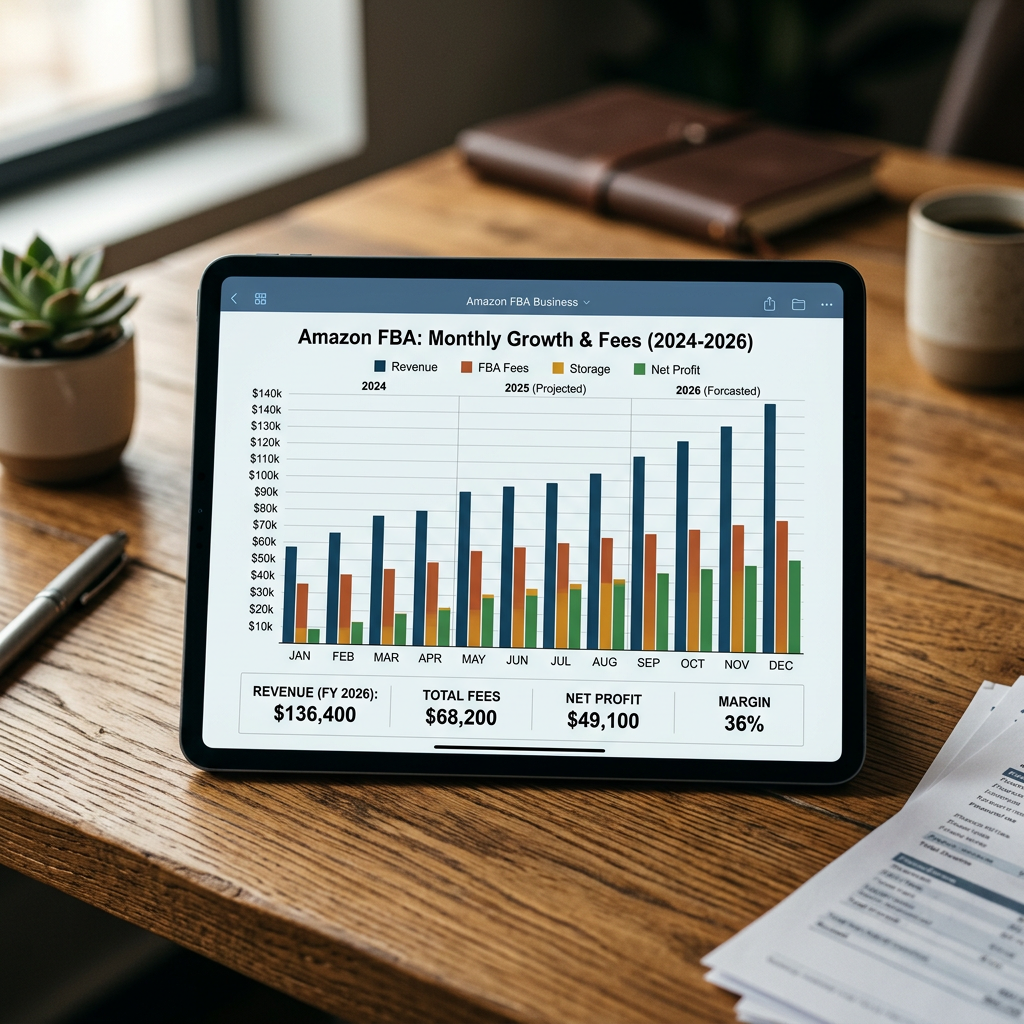
2026 has introduced more nuanced fees that must be itemized in your spreadsheet to avoid year-end surprises. The most critical among these are related to how you ship and hold inventory within the Amazon network.
| Expense Category | Tracking Frequency | Why it Matters in 2026 |
|---|---|---|
| Inbound Placement Fees | Per Shipment | Varies based on single vs. multiple destination split. |
| Low-Inventory Level Fees | Weekly | Penalizes sellers who fail to maintain sufficient stock relative to sales. |
| Peak Storage Surcharges | Oct - Dec | Can be 3x higher than standard monthly storage. |
| Packaging Inefficiency | Monthly | Larger boxes lead to higher size tiers and fulfillment costs. |
For inbound shipments, it is imperative to track the Amazon inbound placement service fees to decide if paying for a single-destination shipment is more cost-effective than shipping to multiple regional hubs.
Advanced Metrics for Your Beginner Spreadsheet
Beyond basic expenses, your tracking should eventually lead to a "True Net Margin" calculation. This is where you use a free Amazon profit margin calculator to bridge the gap between your manual spreadsheet and real-time sales data.
Tracking the "Low-Inventory" Penalty
One of the most disruptive additions to seller costs is the 2026 Amazon low-inventory level fee. Your spreadsheet needs a column to track these penalties specifically. If you find your overhead increasing due to inventory mismanagement, it’s a sign that your capital is not being deployed efficiently.
Storage Fee Escalation
Beginners often underestimate how quickly storage costs balloon for slow-moving inventory. Use a free Amazon storage fee calculator to project these costs for your spreadsheet’s “Worst Case Scenario” tab. By knowing exactly when a product turns from an asset into a liability (long-term storage fee territory), you can trigger liquidations or discount strategies before your overhead eats your equity.
Tip: Review your Amazon FBA product packaging size tiers quarterly. A small change in box dimensions by your manufacturer could shift your product into a cheaper tier, instantly lowering your overhead per unit.
Integrating Marketing into Overhead
While PPC (Pay-Per-Click) is often viewed as a variable marketing cost, there is a baseline "Brand Awareness" spend that many sellers treat as a fixed monthly overhead. In 2026, the rise of video ads and A+ Content updates has made content production a regular expense.
If you are investing in creative assets, ensure these are amortized across the expected lifecycle of the product image. For example, if a professional photo shoot for your product costs $600 and the product will have a 12-month lifecycle, you should add $50 to your spreadsheet's monthly overhead column. This ensures your 50+ Amazon A Plus Content examples translate into actual profit rather than just aesthetic vanity.
Summary of a Successful Tracking Workflow
Managing an Amazon FBA overhead cost spreadsheet for beginners does not have to be a full-time job if you follow a structured monthly workflow:
- Export the Monthly Settlement Report: Download this from Seller Central to get the hard numbers on fees paid.
- Audit the Inbound Fees: Check for discrepancies in placement fees or shipping surcharges.
- Update Fixed Costs: Logic check your software subscriptions—cancel what you don't use.
- Calculate TACoS: Total Advertising Cost of Sale. This helps you see if your total business (including organic sales) is healthy after all expenses.
- Re-evaluate Small and Light Benefits: If your product is under $10, consult the FBA Small and Light program 2026 guide to ensure you are enrolled in the lower fee structures.
Mastering your overhead is the difference between a failing hobby and a flourishing brand. By tracking every dollar that leaves your business, you gain the clarity needed to make aggressive, data-driven decisions that outpace your competition.
Audit your margins today using the ListerRank suite of free seller tools.
Frequently Asked Questions
For 2026, the most common hidden costs are Inbound Placement Fees and Low-Inventory Level Fees, which can significantly alter the per-unit landing cost if not tracked in a spreadsheet.
undefined
Should I include my own salary in the overhead spreadsheet?
Yes. To see the true health of your business, you should include a 'target salary' or owner's draw as a fixed overhead expense to ensure the business is actually profitable enough to sustain you.
How often should I update my FBA overhead spreadsheet?
You should update your fixed costs monthly and your variable product costs every time you place a new manufacturing order or shipment to catch fluctuations in freight and duties.