

Global entrepreneurs selling on Amazon.com face a complex web of state tax obligations that persist regardless of where their headquarters are located. Even if your business has no physical office or employees in the United States, your inventory placement and total sales volume can trigger mandatory registration and filing requirements. Managing non-US resident amazon sales tax compliance in 2026 requires understanding both Marketplace Facilitator laws and individual state economic nexus thresholds.
The Concept of Nexus for International Sellers
Nexus is the legal connection between your business and a U.S. state that grants that state the authority to require you to collect sales tax. For a non-resident, this usually occurs in two ways: physical presence and economic presence. For Amazon sellers, physical presence is almost always triggered by the Fulfillment by Amazon (FBA) program, as Amazon distributes your goods across a massive network of warehouses.
Physical Nexus via FBA Inventory
When you ship goods to an Amazon fulfillment center, those goods become your physical property stored within a specific state. Even if you didn’t choose the warehouse location, the presence of that inventory creates a physical nexus. Understanding FBA inventory nexus and whether Amazon software creates liability is essential for any foreign entity using the U.S. logistics network.
Economic Nexus Thresholds
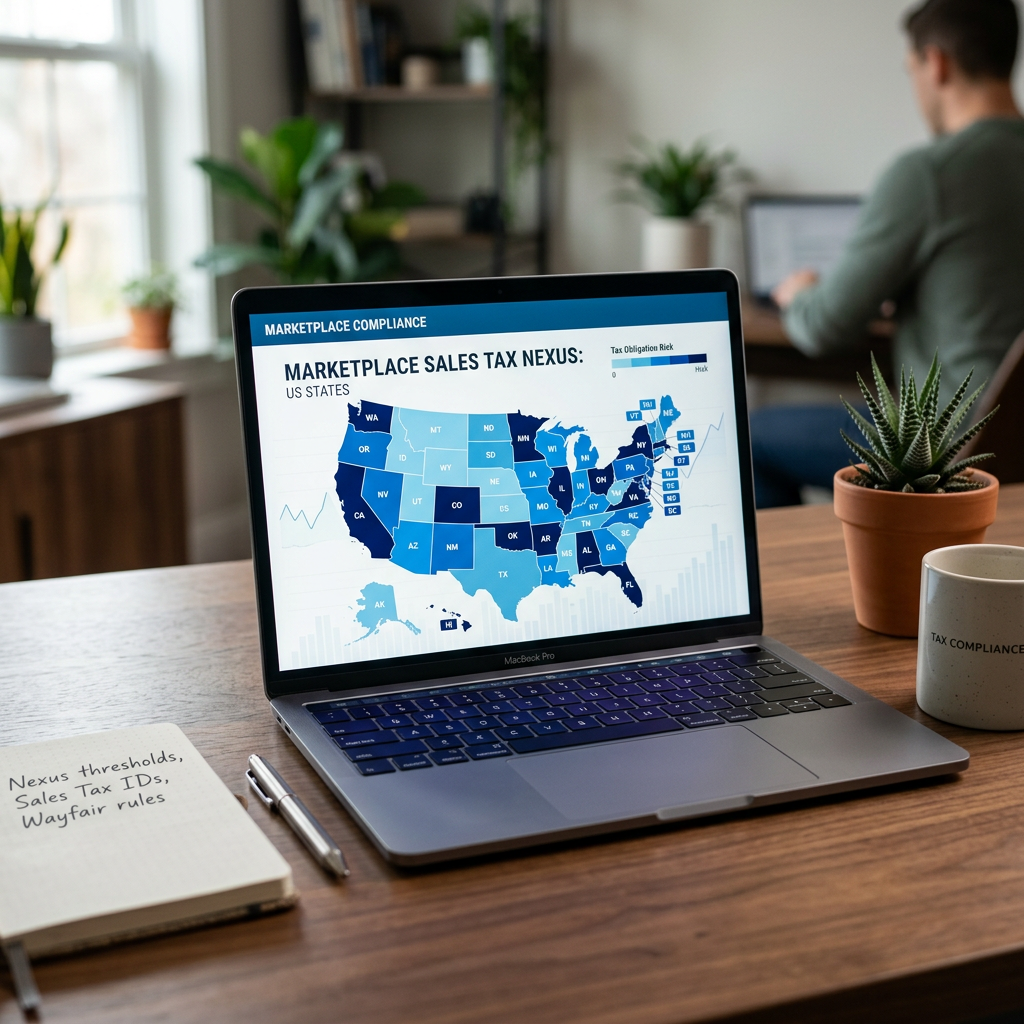
Economic nexus is triggered based solely on your sales revenue or transaction count within a state, regardless of inventory location. Most states have settled on a threshold of $100,000 in gross sales or 200 separate transactions annually. As of 2026, many states have eliminated the transaction count requirement to simplify compliance for smaller sellers, focusing exclusively on revenue.
Marketplace Facilitator Laws vs. Seller Responsibility
It is a common misconception that because Amazon collects tax on most orders, the seller has no further obligations. Under Marketplace Facilitator (MPF) laws, Amazon calculates, collects, and remits sales tax to the state for orders shipped to residents of that state. However, this does not automatically exempt you from registering for a sales tax permit.
| Feature | Marketplace Facilitator Role | Seller Responsibility |
|---|---|---|
| Tax Calculation | Automatic at checkout | Ensure tax settings are correct in Seller Central |
| Tax Remittance | Amazon pays the state directly | Reporting 'zero-tax' sales in some states |
| Registration | Not handled by Amazon | Seller must register if nexus is met |
| Exemption Certificates | Collected by Amazon | Must be provided if purchasing from US suppliers |
In states where you have nexus, you may still be required to file 'zero-tax' returns, reporting your total sales while noting that the tax was collected and remitted by the marketplace. Failure to register can lead to complications if you later expand to your own Shopify store or other platforms. For a deeper look at your specific requirements, consult our sales tax for online sellers guide for 2026.
Registration and the ITIN/EIN Requirement
To register for a sales tax permit in any U.S. state, a non-resident business must typically have a Federal Employer Identification Number (EIN). This serves as your business's tax ID in the U.S. and is required even for foreign entities that do not have a U.S. physical address.
- Obtain an EIN: Apply via the IRS (Form SS-4). Many foreign sellers use a third-party service or a registered agent to facilitate this.
- Determine Nexus States: Identify where your FBA inventory is stored and where your sales volume exceeds the $100k threshold.
- Apply for State Permits: Visit the Department of Revenue website for each relevant state. You will likely need to provide your EIN and foreign business registration documents.
- Distinguish Permits from Licenses: Be aware that a sales tax permit is not the same as a general business license. You can learn more about these distinctions in our article on sales tax registration vs. business license differences.
Tip: If you are purchasing inventory from a U.S.-based wholesaler to sell on Amazon, having a sales tax permit allows you to issue a Resale Certificate. This prevents you from paying sales tax on your initial purchase, significantly improving your margins.

Managing Multi-Channel Complexity
If your business expands beyond Amazon—for example, to TikTok Shop or a direct-to-consumer website—your tax obligations become much heavier. While Amazon handles the collection for its platform, your own website likely will not unless you have integrated multi-channel e-commerce accounting software.
Dropshipping Considerations
If your non-US resident amazon sales tax strategy involves dropshipping from a US supplier to a US customer, the tax implications change. You are the 'middleman' and must provide a valid resale certificate to your supplier. Failing to do so means your supplier will charge you sales tax, which you cannot easily recover. Review the sales tax for dropshipping 2026 guide to understand the requirements for resale certificates.
Using Automation for 2026 Compliance
Managing 45+ states manually is impossible for a growing business. High-volume sellers use software to track nexus thresholds in real-time. For a breakdown of the current market leaders, see our sales tax automation software comparison for 2026.
When calculating your landed cost and potential profits, remember that taxes are just one part of the equation. Use the free Amazon FBA calculator to ensure your pricing accounts for all fees, including the indirect costs of compliance. Furthermore, if you are scaling rapidly on newer platforms, you must understand scaling TikTok Shop multi-channel integration for 2026 to keep your tax data centralized.
Conclusion
Compliance for non-US residents selling on Amazon is no longer optional or a 'gray area' in 2026. By identifying your nexus triggers through FBA inventory and economic thresholds, you can register in the necessary states and avoid costly audits. As you streamline your tax backend, remember that your frontend must remain competitive; use our free Amazon keyword research tool to keep your sales volume high enough to justify your compliance efforts.
Audit your nexus exposure today and use ListerRank free tools to optimize your marketplace performance.
Frequently Asked Questions
Do I need a US bank account to pay sales tax?
While not strictly required by all states, having a US-based or US-compatible digital bank account (like those provided by multi-currency platforms) makes remitting payments to state Departments of Revenue much smoother.
What happens if I ignore US sales tax as a foreign seller?
States are increasingly aggressive in 2026. Failure to comply can lead to back taxes, hefty penalties, and in extreme cases, states can work with marketplaces to freeze your seller account or seize inventory held in US warehouses.
Does a tax treaty between my country and the US help with sales tax?
No. Tax treaties generally cover Federal Income Tax. Sales tax is governed at the state level, and international treaties typically do not apply to state-level consumption taxes.
If Amazon collects the tax, why do I still have to register?
Many states require any seller with nexus to hold a permit and file informational returns. This allows the state to track total economic activity and ensures you are a registered entity if you ever sell products through non-marketplace channels.